
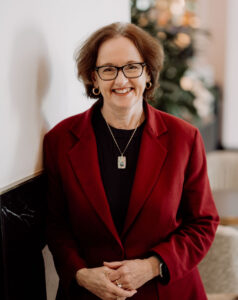
It was a pleasure to speak with Jacqui Walshe in Sydney, to learn more about her role as CEO and Managing Director of The Walshe Group. With offices in Australia and New Zealand, The Walshe Group is the long-term partner and commercial solution for premium airline and destination brands having provided dedicated airline and destination services to some of the world’s most trusted travel brands for nearly 50 years.
Jacqui was born and raised in Auckland. She has a BBS from Massey University and an MBA from Auckland.
For 35 years, Jacqui has been leading the 2nd generation of a family business, that will celebrate 50 years in 2026.
She had been with the business for 12 years, had a two-week old baby and five-year old, when a customer advised that the only way to keep the business would be if Jacqui became involved in Australia. It was a very disruptive time for her. She remembers placing cabbage leaves on her breasts to stop her milk flooding on the flight across the Tasman!
Once there, she gained a sense of being her own person, and a realization that she was in the place she wanted to be.
I asked Jacqui if being a wāhine leader from Aotearoa shaped the way she shows up and leads in a global context?
“Absolutely. Because I was a woman and from NZ, the challenges meant I was excluded from a lot of networking and other professional opportunities. With some aggressive business behaviour from male competititors, I recognised that I didn’t fit the mould and had no choice but to do things differently. I’m naturally entrepreneurial and brought with me ‘#8 wire’ from NZ which is the expression representing the ingenuity and resourcefulness of New Zealanders. I was definitely not willing to give up, and overcame local barriers by virtue of doing business with a global audience. Eventually, my competitors were surprised and somewhat put out that I managed to succeed, regardless!”
What’s one insight or approach you’ve seen overseas that you think Aotearoa could benefit from — particularly in advancing gender equity or inclusive leadership?
“It’s interesting. When I first arrived in Australia, I felt that NZ was the country leading the way. Our Prime Ministers, Governors General, and Judges have been solidly female. Australia didn’t have this kind of representation, but interestingly over time I don’t think either country is where they would like to be. New Zealand and Australian women articulate the need differently, but one thing that is super impressive is in Australian politics where the Labour Party introduced a quota system for female politicians, which is now at a point that 50% of their representatives are women and they hold the majority. The people can see diversity and inclusion and they voted for it.
In Australia’s Parliament there are women across the chamber; they’re in the Cabinet and the quota system isn’t aggressive or unreasonable, it expresses multiplicity. Parliament and the voters are proud of the women in politics, their representation is promoted regularly. Here’s an article from 2025 that highlights women in politics:
Jacqui asks: Could Global Women tell the female political story of New Zealand?
(In 2025, the balance of power in New Zealand’s parliament is nearly even, with women making up 46.3% of the total members, according to data from May 2025.)
Australia has mandatory voting, but NZ doesn’t, however if there are more stories about women in Parliament then more people might vote, especially as the elections are coming up in NZ!”
In moments of challenge or change abroad, what kaupapa or value from Aotearoa do you find yourself returning to most often, and why?
“New Zealand’s approach to Māori and culture has been immersive in the way that NZ does things; it’s an important part of the country. As a member of the NZ Tourism board, I see that culture is such a big part of how we welcome and engage with visitors. The Tourism industry utilises manaakitanga meaning welcome, hospitality and generosity towards others, and showing respect. I think about the ‘people business’ that I’m in through my work in Australia where a huge percentage of people weren’t born in the country. At one stage, I had 31 different nationalities in a team of 100. Some were immigrants – I’m an immigrant – so that engagement across different cultures is about challenge and change. It’s about the people around you, and how you show up and engage with them. Even when times are bad you are supported. And when you need help, they will give it to you. You have built trust through the manaakitanga so it’s beautifully aligned with that whakaaro.”
Thank you, Jacqui, for taking your manaakitanga to Australia and imbuing your leadership with the culture and Māoritanga of your native New Zealand.