
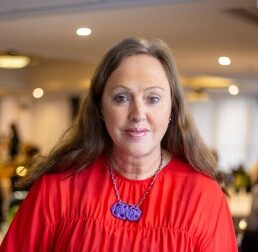
It is always a pleasure to connect with Tania Simpson, to learn from her and to share in her joy for all her roles.
Tania Te Rangingangana Simpson ONZM (Tainui, Ngāi Tahu, Ngāpuhi) is currently a director at Meridian Energy, Waste Management NZ and Auckland International Airport. Tania is a ‘continuing’ member of the Waitangi Tribunal (her warrant has expired but she is completing the existing inquiries she is assigned to) and Chair of the Waitangi National Trust.
Tania has extensive experience in corporate governance, policy development and business with a long history of governance roles. She also holds the distinction of being the first Māori director on the Reserve Bank of New Zealand Board where she was the Deputy Chair.
Tania is an Officer of the New Zealand Order of Merit for services to governance and Māori. The title sits alongside others Tania already holds, including the rank of Commander in the Order of the Taniwha, a tikanga-based honour system established by Kīngi Tuheitia in 2014 to celebrate the efforts of Māori; and the rank of Dame Commander in the Order of St Lazarus, a charitable order established in Europe in 1098 that has been active here since 1962.
She has served 15 years (and counting) with the Waitangi Tribunal as a panel member on a wide range of inquiries. She founded Māori Consulting company Kowhai Consulting which operated for 30 years employing a team of staff based in the Waikato Maniapoto region.
Before we begin the questions, here are a few details of Tania’s background:
Tania was born & raised in Ōtorohanga, and moved to Te Kuiti when she was five.
She now lives in Mātangi in the Waikato. Tania has a son and a daughter.
She graduated from Waikato University with a Bachelor’s Degree in Maori Studies and from Te Wananga o Raukawa with a Masters in Mātauranga Māori. Tania also studied courses on Negotiation at Harvard Law School.
As the first wahine to Chair the Waitangi National Trust, please provide an overview of the Estate, and your role as Chair. Have you been supported in your role?
“The Waitangi National Trust (WNT) is a private Trust that holds the Waitangi Estate for the benefit and enjoyment of all New Zealanders. The Estate was purchased out of private ownership by Lord and Lady Bledisloe in 1932. The land spans some 500+ hectares, and encompasses the Treaty House, the Treaty Grounds where Te Tiriti was signed, the Whare Runanga which commemorates 100 years since the signing of Te Tiriti, the ceremonial waka Ngātokimatawhaorua, a golf course, hotel, sports grounds, pony club, bike and walking tracks, lots of native birds, including many kiwi. The grounds have beautiful views of the Bay of Islands, are largely undeveloped and contain heritage and environmental elements. The Bledisloes also donated a block of forestry to help fund the estate. The forest is now managed by DOC who charge fees after which the WNT gets a portion of any revenue.
The Trustees are appointed to represent all of NZ therefore we have Trustees representing geographical locations and populations throughout NZ, those who represent significant figures in the history of the signing of Te Tiriti, such as the Wiliams and Busby families as well as four of the significant chiefs of the Bay of Islands. These Trustees oversee the Estate, together with a company that runs the estate and its commercial development. The Trust Board operates at a high level of governance oversight and as Chair I facilitate the operations of the Board.
My term as Chair terminates in June 2026, exactly a year after I assumed the role. I’ve been very well supported to become the chair, and to be the chair. With the Trustees, directors and management knowing it’s a short term they have been very supportive in ensuring that I get the opportunity to achieve my goals in this year.
I’ve been mindful during my time as a Trustee to ensure that there’s a place for women’s leadership at the Waitangi Estate and that we are flexible in the way that we exercise tikanga to ensure that women’s leadership is provided for, and respected.”
As the Chair for the Waitangi National Trust, and a representative of a Rangatira, are you leading differently from the Tane who have preceded you? And what are your desired outcomes?
“Governance has evolved and changed a lot in recent times, and I’ve had the good fortune to be on a number of boards with experienced governors and to witness good governance practices. My style of leadership is that I see myself as a facilitator bringing the best out of everybody around the table and finding opportunities for all of our Trustees to lean in and contribute. This creates a really strong functioning team when our Trustees can see the results their skills bring to the work that we’re doing.
We are at a pivotal time for the Estate where we need to turn our minds to thinking about how to maximise the opportunities for the whole Estate rather than be solely focused on the tourism product of the Treaty grounds. My goal is to lay the foundations for the future growth of the wider Estate.
As I mentioned earlier the Estate is for all NZers and there’s a lot of latent potential in the property, so we are looking for opportunities to partner with others to create more activities for more people to participate in. That may come about by uplifting the existing activities and also by adding new developments.”
How could Global Women participate in, and help to strengthen opportunities for wahine Māori throughout Aotearoa?
“Global Women of the North has set a really good example in terms of Māori and Pākehā/tauiwi women leaders coming together to engage, support and collaborate. I encourage all women to take the opportunity to engage as we have a lot to learn from each other… we will rise together through these encounters. It requires some relationship -building, some deep humility and a willingness to learn from each other and to be uncomfortable sometimes. When women are prepared for this journey then I believe we will progress well together in a way that the Treaty partnership envisaged.”
Recently, the Waitangi National Trust partnered with Global Women of the North to deliver a dinner event honoring 𝙏𝙚 𝘼𝙧𝙞𝙠𝙞𝙣𝙪𝙞 𝙆𝙪𝙞𝙣𝙞 𝙉𝙜𝙖 𝙬𝙖𝙞 𝙝𝙤𝙣𝙤 𝙞 𝙩𝙚 𝙥𝙤 following her economic initiative. What were the outcomes for collaborative economic development for Te Tai Tokerau?
“The first outcome is to promote the sense that the Waitangi Estate is for all of us! We want to let more NZers to know that this is their place and that they can come to Waitangi to hold events and meetings there. You don’t have to wait to be invited or asked – it’s not a mysterious place – it’s our place. Secondly, the message we are giving is that together we are stronger. Through connections with one another, whether we are in corporates, philanthropy, Iwi, councils or government we can achieve a lot for the region. The dinner was designed to be a platform for collective connectivity for Te Tai Tokerau and for the Waitangi Estate.
There are a lot of organisations talking about how they will participate, and many are focused on 2040 and what happens between now and then. There are a series of milestones starting in six years’ tim,e firstly with the Centenary of the Bledisloe Gift of the Estate to the nation in 2032. In 2035 we celebrate the Declaration of New Zealand as an independent nation, and in 2040 we will mark 200 years since the signing of the Treaty of Waitangi, an agreement between Māori who held sovereignty in Aotearoa/NZ and the British Queen who held sovereignty in England. There is a lot of thinking about this significant period of time, how we mark these milestones and what we put in place to recognise and honour them. We’ve started the journey, and we need to answer some of these questions about how the ‘what’ will be achieved for this period.”
When you look ahead to 2040 and our current relationship to Te Tiriti o Waitangi, how do you view the future for Māori and Aotearoa?
“We (Māori and Pākehā) come from very different cultures. The difference is not always well understood therefore the more we understand each other the more we can learn how to bridge the divide. One of the big differences is the extent to which we know our shared history and the colonisation experience from each other’s perspectives, and the Treaty is a big part of that. It’s the umbrella for understanding that difference and so if we want to really understand each other and come closer, we need to come together and learn about this history.
I think the expectations that arise from the Treaty of Waitangi are actually a fairly low bar for us to meet. We can do even better than that. Those arrangements were made for that time in our history, and for setting a foundation for the future. We should have evolved to an even more ambitious arrangement, notwithstanding that we haven’t yet given effect to those arrangements and that promise. We need to look at it now and go even further.
Our nation can lead the world at a time when the world is struggling to deal with relationships, difference, unity, and diversity. The Treaty gives us the foundation of a model that recognises and respects differences in identity, culture, societal infrastructure and more, and makes a place for those differences to coexist. But we haven’t done it properly so we also need to go further and show that we can live together, alongside each other, and respect our differences. We must apply our minds to new models and not continue to apply old ideas such as the Westminster model which is now somewhat redundant, and stop dragging that ageing infrastructure into a world for which it is no longer appropriate.”
And Tania’s closing thoughts:
“I am thankful to have had this opportunity to talk about what’s on my mind, not just for the Waitangi Estate, not just for Northland and not just for women, but for our nation. We are all intelligent people, and we have the opportunity to do much better.”
Nga mihi nui, Tania, for your foresight, insights and intelligent governance for Aotearoa New Zealand.