
Leading Bold Change from Aotearoa to the World
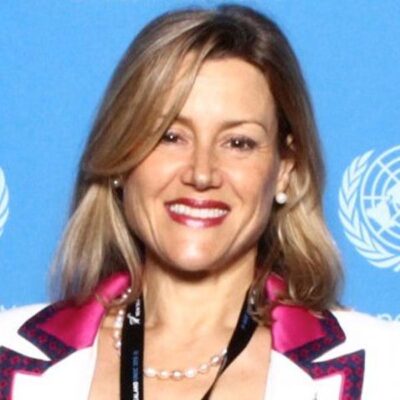
As part of our ongoing Member Interview Series, Jenni Prisk sat down with Amanda Ellis, a globally recognized leader in sustainable development and international relations. Amanda currently serves as Senior Director, Global Partnerships and Networks for the Julie Ann Wrigley Global Futures Laboratory at Arizona State University, and as Executive Director, Asia-Pacific for the Global Institute of Sustainability and Innovation. She is also the co-chair of the WE Empower UN SDG Challenge, a global initiative launched by the UN Secretary General in 2018.
Her distinguished career includes serving as New Zealand’s Head of Mission and Ambassador to the United Nations in Geneva, She went on to co-chair the UNSC’s High Level Working Group on Humanitarian Access into Syria. As New Zealand’s inaugural Ambassador for Women and Girls, she championed gender equality on the world stage. From 2010 to 2013, she was Deputy Secretary International Development and the first woman to lead the New Zealand Aid Programme, managing an annual budget of over $600M.
During her tenure at the World Bank Group Amanda managed the President’s Global Private Sector CEO Leaders Forum and created the “Women, Business and the Law” research project. A celebrated author, Amanda, has written two best-selling books, Women’s Business, Women’s Wealth and Woman 2 Woman, and is a lead author on five World Bank research titles.
Her achievements have been recognized with the TIAW Lifetime Achievement Award and induction into the NZ Business Hall of Fame.
Amanda serves on numerous advisory boards, including the Global Governance Forum, Blue Planet Alliance, Open Planet and Generate Zero. She is an Adjunct Senior Fellow at the East-West Center. Ellis holds a BA First Class Honours from the University of Otago, an MA from the University of Hawaii at Manoa (where she met her American husband on an East-West Center scholarship) and an LTCL from Trinity College of London. She has also completed executive education programs at Harvard, Stanford, Oxford and INSEAD. Amanda’s home base is now Hawai’i.
With all this power in her pocket, Amanda remains humble, authentic and engaging.
My first question to Amanda: How has being a wāhine leader from Aotearoa shaped the way you show up and lead in a global context?”
“I’m immensely proud that in 1893, Aotearoa NZ was the first country in the world where women won the right to vote. This gave us very important positioning globally. We have had three strong, principled female Prime Ministers, all with the ethos of supporting other women, recognising the importance of outreach and engagement to both educate and to garner support for issues of global importance like human rights and climate action, and privileging the Treaty of Waitangi and the partnership with Māori. Having female role models at the highest level inspired me to believe women should have equal opportunity.
As a young diplomat in 1988, I was excluded from doing my job as Secretariat for the Pacific Economic Cooperation Conference (PECC) because I was female.
The meeting was to be held at the Wellington Club, an all-male bastion that wouldn’t even allow me inside! It was a moment of reckoning. I’d joined the Foreign Ministry because I wanted to make a difference. Now I couldn’t even get into the meetings where they were talking about it!
When I went to tender my resignation, because of this situation, I asked the Secretary of the Foreign Ministry: ‘would you feel comfortable about my being similarly excluded on the basis of race?’ He immediately saw the situation in a different light, and proposed writing to the Wellington Club ‘to remind them that it was 1988 and women were entering the workforce in greater numbers and they would hence lose revenue by remaining all male.’
Secretary Norish also suggested that ‘while the Foreign Ministry is a hierarchical place, I suggest you seek out senior women and discuss this with them.’ I did and we founded a women’s network. The following year we celebrated at the newly gender equitable Wellington Club!
I gained three lessons from this experience:
- 1. The importance of the business case.
- 2. The critical role of networks (Global Women is an excellent example.)
- 3. The importance of sharing a problem rather than leaping to your own solution.”
What’s one insight or approach you’ve seen overseas that you think Aotearoa could benefit from — particularly in advancing gender equity or inclusive leadership?
“I think bold action for transformative change that has a multiplier impact.
When I went to Australia for Westpac Banking Corporation as head of Communications, I gained the incredible opportunity to work with Bob Joss from the US. Arriving in Australia, greeted by a lineup of men in blue suits, he asked ‘where are the women in corporate Australia?’ He ultimately supported me as inaugural National Manager for Women in Business, utilising the business case based on Joss’s equitable initiatives at Wells Fargo and responding to research revealing 40pc of women customers felt discriminated against. The business case won over initial sceptics.
After three years, we were turning over $504m in analysed revenues, that we could directly track to our Women in Business team.
I’ve witnessed transformative change through bold leadership, in my role at the Julie Ann Wrigley Global Futures Laboratory. Julie made a huge endowment to ASU when her Alma Mater Stanford University refused to agree to her request that there should be compulsory sustainability education for every student. ASU made it compulsory and is now ranked #1 in sustainability in the US.
When we observe transformative change occurring by bringing courageous people together through the power of collective action, we must maintain it in NZ!
And I must add kudos to the many NZ Global Women members who are entrepreneurial change agents. WE Empower UN Global Awardee 2023 Andy Blair and finalists Chris Duggan, Florence Van Dyke and Brianne West saw a problem, built a network and an ecosystem to address it and have received global recognition as a result. As has Carmen Vicelich with Valocity and Generate Zero. “
In moments of challenge or change abroad, what kaupapa or value from Aotearoa do you find yourself returning to most often, and why?
“Kaitiakitanga. The notion of stewardship and the importance of indigenous wisdom.
Indigenous peoples represent 5pc of our global population yet are stewarding 80pc of remaining biodiversity on our planet. I’m fortunate to work with global organizations like The Earth League and the Intergovernmental Panel on Climate Change where I see intergenerational consciousness and connectivity being privileged. In Māori, we repeat ‘tena koutou’ as a greeting three times, once for the past, once for the present and once for future generations. Sadly, many people are thinking only short- term.
Despite all we know about the climate crisis and the huge damage being caused, financial institutions have invested $7 trillion in fossil fuel development since the 2015 Paris Agreement on climate change.
Vested interests have captured the politicians who are mortgaging our children’s futures at long term expense as costs – environmental, human and financial – are rising exponentially. The bright spot? Where women lead – as politicians, on boards, in senior management and as entrepreneurs, the longitudinal data now clearly shows there is higher likelihood of attention and action on sustainability, climate, biodiversity, girls’ education and intergenerational well-being. “
Amanda, mahalo for your incisive global leadership, in-depth strategizing, and love of our planet and people!