
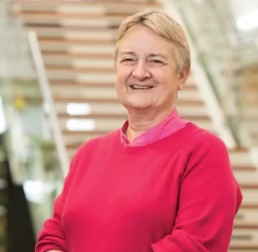
As part of our ongoing Member Interview Series, Jenni Prisk sat down Dame Marilyn Waring.
Marilyn Joy Waring DNZM is a New Zealand public policy scholar, international development consultant, former politician, environmentalist, feminist and a principal founder of feminist economics. In 1975, she became New Zealand’s youngest Member of Parliament, for the National Party. Marilyn left Parliament in 1984 and moved into academia, completing her Ph.D in political economy in 1989. In 1988 Marilyn published her widely-renowned book, If Women Counted. The book persuaded the United Nations to redefine gross domestic product, inspired new accounting methods in dozens of countries and became a founding document of the discipline of feminist economics.
In 2014, the anthology Counting on Marilyn Waring: New Advances in Feminist Economics was published. The authors explored a wide range of issues—including the fundamental meaning of economic growth, a universal basic income, health care, mortality, unpaid household work, mothering, education, nutrition, equality, and sustainability.
Marilyn was born in Ngāruawāhia, grew up in Taupiri and now, to my delight, lives in the Bay of Islands.
Please visit the link: www.marilynwaring.com to learn so much more about our Global Women member and amazing wahine!
I had the pleasure of sitting down in Marilyn’s home for our interview. She has only recently caught up on rest and sleep since delivering the People’s Select Committee Inquiry into the Equal Pay Amendment Act 2025. I asked Marilyn what prompted her to undertake this herculean task.
“Like most people across New Zealand I seldom listen to Parliament. But we found ourselves sitting in front of the TV in early May 2025, listening to this outrageous exercise of power directed at over 180,000 New Zealanders, most of them poorly paid women. I signed the petition and watched demonstrations and protestations on the second day of the Parliamentary debates but I felt devastated and powerless.
I got an email (just before going for a swim) from a friend who worked at PSA HQ saying ‘is there anything you can think of that we could be doing?’ I’m one of those swimmers who talk to themselves in the water. After a few laps, I found myself articulating that what we needed was a device that could capture all the evidence that should have been in front of Parliament when this Bill was debated, and the obvious answer to that is a Select Committee! I began to think of former women MPs I could ask to jon me. The list included Global Women members – Lianne Dalziel and Steve Chadwick – and old friends like Jackie Blue and former PhD student Dr. Sue Bradford. I started making phone calls including to two women MPs whom I’d never met. Everyone said ‘yes’ immediately. However, none of us knew how we were going to do this!
With 10 names and cross-party representation, I went back to my PSA friend to say ‘OK, we’ve got a strategy! A Select Committee!’ I flew to Wellington to announce the establishment of the Committee and by the time I returned to the North that evening, my email inbox was already overloaded with people wanting to know how they could help and what they could do.
Among these people were Len Cook, the former Director General of Statistics NZ and former EEO Commissioner Karanina Sumeo. We were advised that Amy Ross, the leading international expert on Pay Equity – and a Kiwi – would make herself available to help. So we now had our “departmental advisors.” The pay equity advisors at the CTU and PSA provided our secretariat, handling logistics, streaming, the website, Dropbox, etc. All we needed was a Committee Clerk. Former parliamentary clerk, Beth Bowden, called me saying she’d love to fill the role!
We received 1383 substantive submissions, we held 10 public hearings, each chaired by a different member of the Committee. We also received $40,000 from 902 donors in 11 weeks on our ‘Give a Little’ page to help pay for the hearings and the website, and to insure we would get a printed copy of our report into every public library in New Zealand.
In the 48 hours following a dinner presentation to a Global Women event in Auckland, the donations to our page increased significantly (mostly from anonymous donors to whom we are deeply grateful.) At the event, I was speaking about quotas on boards but all the audience questions were about the Select Committee!
People don’t understand that the 1972 Equal Pay Act included pay equity. It is clear when you read the Hansard debate – and both sides of the House refer to the “mythical man” – that they understood that pay equity needed comparators. But it wasn’t until the High Court case brought by the Care and Support workers in 2013 that the NZ Courts finally recognized what the intention of Parliament had been.
The 1972 Act was passed unanimously; the only opposition to the Act was from the Employers Federation. The Prime Minister, Sir John Marshall, commented that it ‘was a matter of social justice’ and ‘a landmark in our social history.’
The 2020 amendment was also unanimously supported across the House and agreed to by BusinessNZ and Union representatives. Three years later the Finance Minister, Nicola Willis, saw the Pay Equity funds as a bank she could loot for other spending priorities. No budgetary savings were made.
The Committee found no evidence whatsoever to support government claims that the system had been gamed. The other key finding was that the comparator design and process was world-leading, exceptionally rigorous, and of post-doctoral standard.“
Have you had responses from Central Government following the delivery of your Report in February 2026?
“Three of us put the name of every Member of Parliament on a copy of the report and this was delivered to each MP within 24 hours of our press conference. We were surprised and delighted that National’s Deputy Speaker Barbara Kuriger, Labour leader Chris Hipkins, Labour Finance spokesperson, Barbara Edmond, Julie Anne Genter, Green Party MP and Qiulae Wong, the leader of the Opportunity Party, attended our Report launch on 24 February 2026.
We have provided a report that will be used 1) by the unions and the Court in the Declaration of Inconsistency case; 2) in the report being made to the Commission on the Status of Women; 3) by the Waitangi Tribunal in their hearings on WAI 2700 – Mana Wahine Kaupapa Inquiry. And 4) it’s available for everyone before they cast their vote! So it has a life!”
Have you put any (joint) actions from the Report into practice?
“Members of the Select Committee are being asked to speak to social service employers, at gender and equality conferences, and to union meetings.”
Has action been taken by the government on the 33 Claims that affected 18,000 workers?
“Unions representing Hospice, and Plunket have proceeded with claims under the new regime because they should be directly comparable with nurses in the public sector whose pay equity settlements see them paid 30% more. I expect the unions will win these cases but then the excitement ensues. Hospice and Plunket cannot afford these increases and the government will have to pay. They are part of the “funded sector” and the government does not fund the costs of pay equity increases in this sector.
Both Plunket and Hospice had used charitable donations to fund the pay equity process before the change in the law. Plunket advised Law News that a phone call to their help-line maxes out at $40 per call. Compare that with turning up at an emergency service.
Hospice estimates they save the country $110m annually through their services, certainly as much money as they are funded. Many employers and unions had spent more than half a million dollars each pursuing the 33 claims that were stopped by the legislation.”
Please tell us about breaches of law for Te Tiriti o Waitangi, CEDAW and other policies that are affected by the EPAA.
“WAI 2700 Mana Wahine Kaupapa Inquiry will hear evidence later in 2026 which alleges prejudice against wahine Māori as a result of Treaty breaches by the Crown. We found a breach of partnership with exclusion from any consultation, and we also found a breach of Article III – the failure to insure equity.
In international law, we found breaches of the Civil and Political, Economic Social and Cultural, Rights of Persons with Disabilities, Elimination of Discrimination against Women, and the Elimination of All Forms of Racial Discrimination Conventions, as well as breaches of our Human Rights Act 1993.
Global Women members Hon. Margaret Wilson, Dame Sylvia Cartwright, Tracey Houpapa and others outlined at the hearings the abuses of a constitutional legislative process including retrospective legislation, the failure to provide a regulatory impact statement, and a breach of the Rule of Law.”
Do you have recommendations for Global Women members to work for pay equity in their organisations/businesses/individually?
“Global Women members must read Section 7 of the Report titled: Fishing and Finding: Comparing Jobs. (www.payequity.org) Many GW members belong to BusinessNZ and they were not consulted by BusinessNZ when the organisation supported this legislation. We need employers to understand the system. Then they will not have to join the ranks of those who thought it was funny (while undignified and demeaning) to compare a librarian with a fisheries officer!”
After your significant and meticulous compilation of the 174-page People’s Select Committee Report what are the next steps for the PSC?
“We have been approached by the Turnbull Library, asking if they can archive everything – including the menus of the dinners that Zonta Wellington provided us with for the launch of the committee and for the presentation of the Report.”
And Marilyn’s closing remarks:
“We were overwhelmed by the trust placed in us by submitters and supporters. And as you can imagine, this entire exercise took thousands of hours of unpaid work!!”
Thank you Marilyn for all you continue to contribute to New Zealand, especially for women, justice and human rights. You are a national treasure!