

Reflections on the Global Women Japan Study Tour
Annah Stretton
There is something valuable about finding yourself in a room where your own experience is only one part of the knowledge available. In our working lives, particularly when we lead organisations, we can become accustomed to being the person others look to for answers. That is useful for running a business, but it does not always extend us.
Eight days in Japan with 18 women from across Aotearoa allowed me to occupy a different space. These were capable women whose experiences stretched across business, governance, government and other fields of leadership. We had much in common, but there were also substantial differences in how we worked, what occupied our thinking and where we believed change was needed. Those differences gave the conversations their substance.
The Japan Study Tour brought together leadership, economic insight and cultural exchange. For me, its value lay in the relationship between those elements, and in having enough time together for the conversations to move beyond introductions.
I have been a Global Women member since 2010 and previously joined the tours to India and San Francisco. My connection with the organisation has varied over those years. As an entrepreneur working across fashion, social enterprise, the charitable sector and the arts, I have sometimes felt less directly connected to a network that, from my perspective, has a strong representation of corporate chief executives and professional directors.
Japan renewed that connection. It reminded me how much there is to gain from spending sustained time with women whose leadership takes a different form from my own.
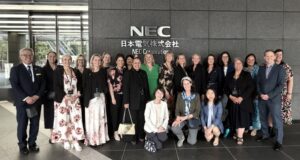
Our opening days in Tokyo provided a strong foundation. Conversations at the New Zealand Embassy and a leadership forum with senior Japanese government and business leaders gave us access to perspectives that would have been difficult to encounter independently. An economics briefing and leadership lunch at PwC, alongside a technology briefing with NEC, created opportunities to consider Japan through the experience of people working within its institutions and businesses.
The significance of that access goes beyond the information presented. It allows us to ask questions, test assumptions and recognise the limits of what we understand. An unfamiliar economy becomes more intelligible when we can hear directly from those navigating it.
As the programme moved towards art and culture, I found myself increasingly absorbed. Travelling by bullet train, staying at Benesse House on Naoshima and visiting the Naoshima New Museum of Art were particular highlights. Here, we had time to engage with the stories and intentions behind the work, as well as its visual presence.
As someone whose own practice moves between fashion, photography and social inquiry, I valued that attention to context. An image or an artwork can be immediately compelling, but understanding something of its making changes the encounter. It asks more of us as viewers. It also raises questions about what we notice, what we overlook and how quickly we assume we understand.
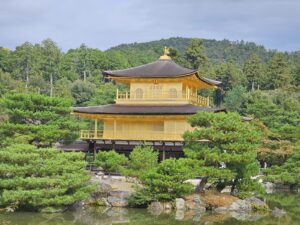
Kyoto offered further opportunities to slow down, including our visit to Kinkaku-ji, the Golden Pavilion, and a Zen meditation experience. Back in Tokyo, teamLab Borderless brought us into a very different encounter with art, through immersive digital environments. Across these experiences, there was considerable scope to think about creativity, awareness and the conditions that allow people to see differently.
For capable women accustomed to full schedules and responsibility, making room for that kind of attention has value in itself.
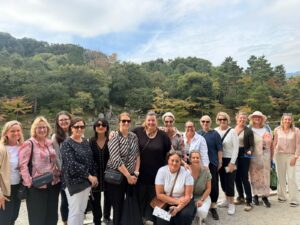
The smaller group was one of the tour’s greatest strengths. With 18 of us, there was a fluidity to how we spent time together. It mattered very little who you sat beside on the bus, joined you at breakfast or you found yourself walking with. Conversations developed across the group, and there was room to get to know people beyond their professional identities.
We talked about our work, but also children, ageing parents, grandchildren, sport, art, photography and the things that brought us joy. I watched women move easily between rigorous business conversations and the care and concern they carried for family and friends. That breadth is part of their capability as leaders.
The group’s photographic energy was another delight. A dedicated WhatsApp feed for photographic images became a generous shared record of our journey. There were talented photographers among us, and seeing what others had noticed added another dimension to my own experience.
These interactions are important because relationships require more than proximity. They need time, repeated encounters and opportunities for people to revise their first impressions.
Even within this trip, it took a few days for everyone to settle. We arrive with assumptions about others, and sometimes uncertainty about ourselves. Do I belong here? Will my experience be understood? Will the language of another sector make my own contribution feel less relevant?
I recognise those questions. I also recognise how easily we can make premature judgements about people we scarcely know. Some of the most rewarding connections on this trip came from allowing those judgements to be unsettled.
In my work with RAW, relationships are central to what becomes possible. Trust develops through consistency, shared experience and reciprocity. That understanding also shapes how I think about a leadership network. Through a Māori relational framing, whanaungatanga helps articulate the importance of building and sustaining connection, while manaakitanga asks us to consider how we care for others and uphold their mana.
Those ideas carry responsibilities. If we want a network in which women support one another, we need opportunities to know one another well enough for that support to have substance. A two-hour event or an online presentation can introduce us to someone’s thinking. Eight days together can begin to build the relationship through which we understand when to offer support, ask for help or make a useful connection.
There was a comment on the bus that we should establish a political party called “Women Who Get Shit Done”. It prompted laughter, but it also reflected something evident within the group: considerable capability, practical judgement and an appetite to contribute. The question is how we create the conditions for that capability to travel further.
This is where I see the importance of Global Women’s purpose around diversity and equity in leadership. I would welcome stronger representation from entrepreneurs and women leading NGOs and community organisations. Different forms of leadership bring different knowledge, accountabilities and measures of success.
Membership networks can also reproduce their existing composition through familiar referral pathways. Broadening those pathways would strengthen the diversity of experience available to all of us. That is an opportunity for an organisation whose purpose I value and with which I have returned feeling reinvigorated.
The question of exclusivity deserves an honest response. At approximately $18,000 before flights and additional personal costs, this tour represented a substantial investment. It will not be accessible to everyone. That is a real consideration, but price alone does not settle the question of its value or purpose.
For those of us living outside Auckland, participation in the network already requires choices about time, travel and what an event is likely to deliver. Living in Hamilton, attendance at GW events requires distance and often a personal reluctance. An extended international experience offers a different depth of engagement, and this one strengthened my connection with the organisation in a way that occasional attendance has not.
The broader value depends on what we do with the experience: how it informs our leadership, expands our relationships and contributes to the organisations and communities we return to. Bringing capable women together deserves to be assessed through those outcomes.
The organisation of the tour made that engagement possible. The accommodation was superb, and the practical support allowed us to give our attention to the programme and one another. Bianca from Fortis Events was exceptional. Even after the group had dispersed, her message confirming my airport pickup reflected the care that had been evident throughout. Delivering an experience like this has a cost, and the value of her contribution was substantial.
If I were to suggest one area for refinement, it would be the consistency and range of the food experiences.
There were excellent meals. The PwC lunch was a standout, both for its quality and its thoughtful response to dietary requirements. Rather than leaving those with allergies with visibly reduced alternatives, the meal accommodated those requirements across the group. It was delicious, and a practical example of inclusion improving an experience for everyone.
Our final lunch at L’Atelier was another highlight. So was a very different evening in Kyoto, when Mel Hewitson helped lead us to a small restaurant recommended by the hotel. We found our way through alleyways to an unassuming space that delivered a wonderful meal and an experience I would have been unlikely to discover alone. Including, possibly too much beer, it cost around NZ$30 each.
That evening reinforced how little the quality of an encounter necessarily depends on its price or formality.
Some other meals were less successful for me. I found the shabu-shabu food experience underwhelming, and the dinner at Censu fell short in both the food and the coordination of service. Given Japan’s culinary reputation, I would have welcomed a more consistently strong selection, including an inventive and artistic sushi or sashimi experience. The opportunity is to bring the same level of considered selection to the food that was evident across so much of the wider programme.
I would readily join another tour to a destination that interests me. Although the planned Ireland trip falls alongside important family commitments, future possibilities in Mexico, South America or South Africa would have considerable appeal. There are places we are curious about but may hesitate to navigate independently. A well-supported programme with an engaged group makes those encounters possible, while providing access and conversation that we would struggle to arrange ourselves.
Finally, to Katie Bhreatnach: I have loved getting to know you better. Your Annie Hall quirk, your fearless approach and the capability underpinning it have been a pleasure to experience at closer quarters.
I came to Japan curious about the country. I return creatively energised, with deeper relationships and a renewed belief in Global Women. The tour gave us time to discover what sits beyond one another’s titles and sectors, and to appreciate the different contributions we can make. That is a strong foundation for women advancing themselves, supporting others and leading change.